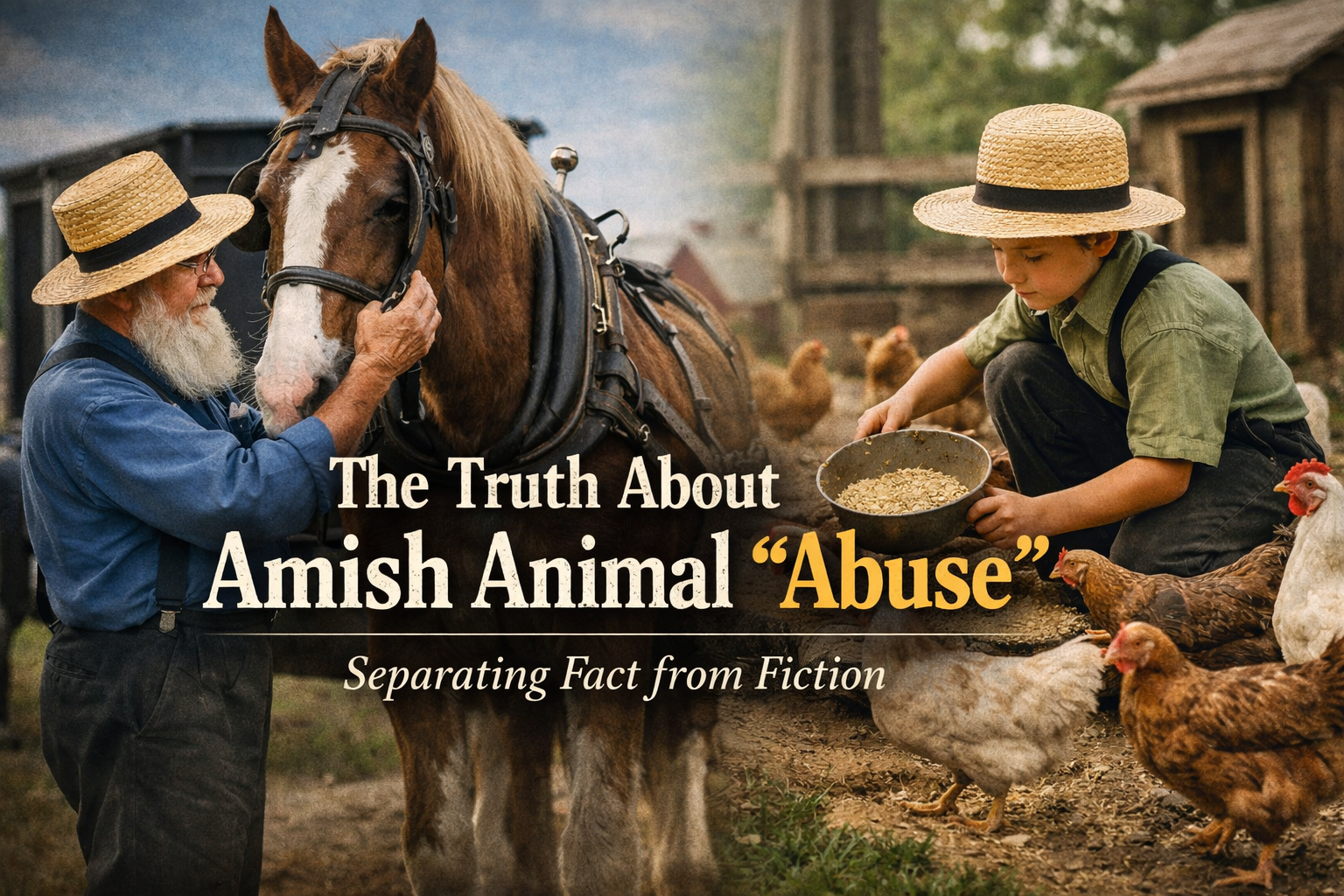
A Perspective Most People Won’t Say Out Loud
There’s a common belief—especially online—that the Amish are abusive to their animals.
And I’m going to say something that might surprise you:
That statement is both true… and deeply misleading.
Let’s talk about it honestly.
Yes—Abuse Happens
There are documented cases of animal neglect and mistreatment in Amish communities. That is real, and it should never be ignored or excused.
But here’s the problem:
Abuse exists in every community.
- Professional breeders
- Suburban pet owners
- Rescue organizations
- Even well-meaning families
To single out one group as uniquely abusive isn’t just inaccurate—it’s unfair.
The Harm of Blanket Statements
When people say “the Amish are abusive to animals,” what they’re really doing is reducing an entire group of people—thousands of families, beliefs, and practices—into one label.
That’s not discernment. That’s stereotyping.
And it shuts down real conversation.
What Is Animal Abuse, Really?
Before we point fingers, we need to define what we mean.
Animal abuse isn’t:
- Using animals for work
- Raising animals for food
- Keeping animals outdoors
- Expecting animals to have a purpose
Animal abuse is:
- Neglecting basic needs (food, water, shelter, medical care)
- Causing unnecessary suffering
- Ignoring pain, injury, or illness
- Overworking to the point of harm
There’s a difference between use and abuse—and that line matters.
A Biblical Perspective on Animals
From a Christian worldview, animals were never meant to be treated as human equals.
In Genesis 1:26, humans are given dominion over animals.
That word—dominion—has been misunderstood.
It does not mean cruelty.
It does not mean neglect.
It means responsibility.
- Animals are given to us for food
- For work
- For service
But also:
- They are part of God’s creation
- They deserve care and stewardship
You can believe animals have a purpose without believing they should suffer.
The Cultural Divide Most People Ignore
Here’s where a lot of tension comes from:
Modern pet culture says:
“Animals are family.”
Traditional agrarian culture says:
“Animals are livelihood.”
Those two mindsets are not the same.
And when you judge one through the lens of the other, you’re going to misunderstand it.
My Perspective From Inside an Anabaptist Background
I didn’t grow up Amish—but I have an Anabaptist background, which includes Amish communities.
So I’ve seen this from closer than most people speaking on it.
And here’s the truth:
- Some families care deeply for their animals
- Some do the bare minimum
- And yes, some fall into neglect
Just like anywhere else.
The difference is often visibility—not frequency.
Where We Should Draw the Line
If we actually care about animals, the goal shouldn’t be to shame entire groups.
It should be to:
- Call out real abuse when it happens
- Educate on proper care
- Encourage better standards across all communities
Because animals don’t benefit from stereotypes.
They benefit from responsible humans.
Final Thoughts
It’s easy to point fingers.
It’s harder to think critically.
The Amish are not a monolith.
They are not all abusive.
And pretending they are doesn’t help animals—it just fuels division.
If we’re going to advocate for animal welfare, let’s do it with:
- Accuracy
- Fairness
- And a willingness to look at everyone, not just who’s easy to criticize
⚠️ Read my post here on Red Flags to Look for In Dog Breeders And What Questions to Ask






Leave a Reply